
Based on Intuitive Intel’s case study
At a glance
- What we tested: An AI configuration agent, built with our partner Intuitive Intel, running inside VFP’s delivery platform
- What it worked on: 44 real requirements from a live Salesforce implementation, not a sandbox demo
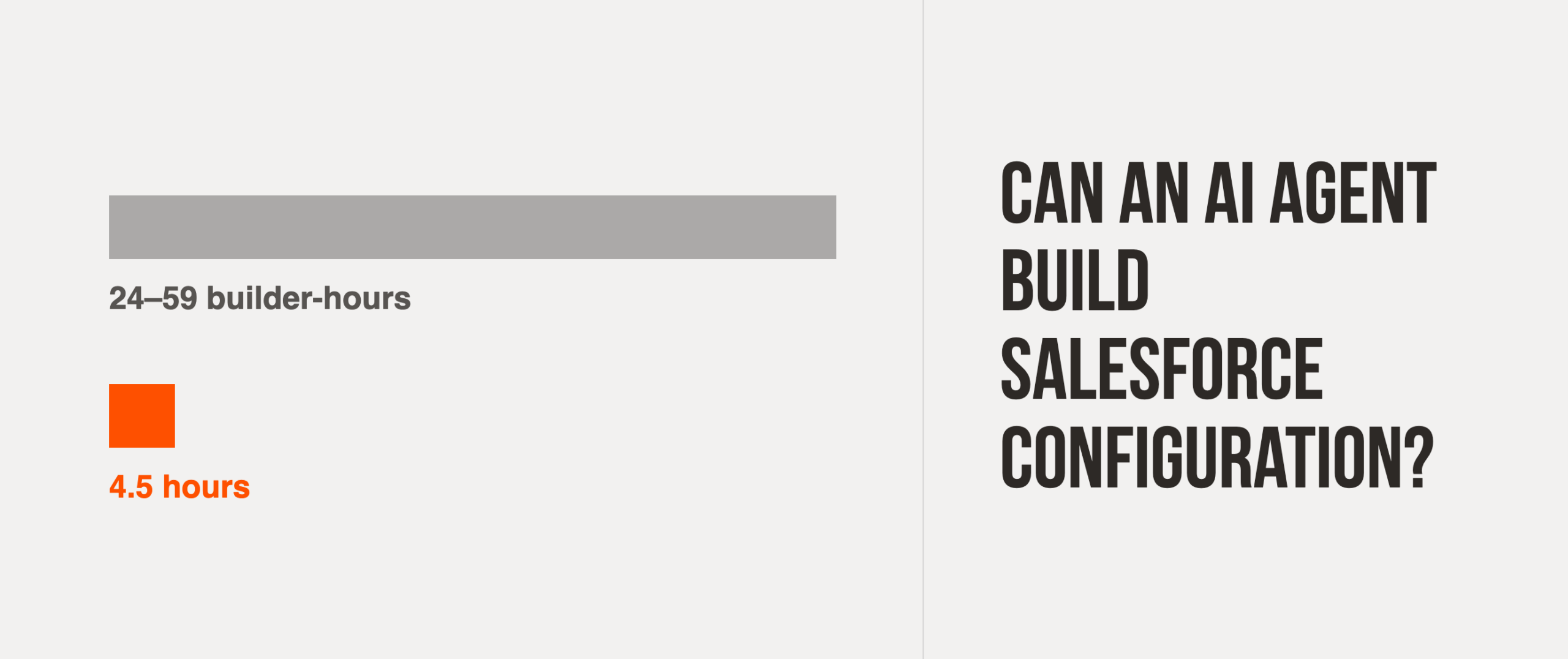
- How long it took: 4.5 hours, against a budget of 24 to 59 builder-hours
- How accurate it was: 97.7% of in-scope components delivered correctly
- What’s next: We’re aiming to cut go-live timelines by 50% on our next two implementations
Why did VFP put an AI agent on a live project?
Quick Answer: Because configuration is where implementation hours pile up. Once requirements are signed off, a large share of the budget goes to careful, repetitive build work in Setup. We wanted to know whether an agent could take that work on without cutting corners, and a live project was the only honest way to find out.
Demos are easy to win. Real requirements come with messy edge cases, dependencies, and a client waiting on the other end. So in August 2026, our consultants handed the agent the same requirements our builders would have worked from and compared the results against the budget.
What happened when the agent took on the build?
Quick Answer: It finished 44 requirements in 4.5 hours. The same work was budgeted at 24 to 59 builder-hours, which means roughly 82% of budgeted build hours came off the table. And it got 97.7% of the contracted components right on the first pass.
The numbers are good, but what surprised us was where the time went back. Our consultants didn’t disappear from the project. They spent it reviewing output, pressure-testing the design, and talking with the client about what actually matters to their business.
Does this mean AI replaces Salesforce consultants?
Quick Answer: No. The agent handled the build. People still owned the requirements, the design decisions, and the review. Without clean, well-structured requirements, the agent has nothing reliable to build from, so upfront consulting matters more now, not less.
That’s the part we think most firms will miss. We gained speed by pairing the agent with an already disciplined requirements process. Building faster on vague requirements just gets you to the wrong answer sooner.
What should Salesforce teams take away from this?
- Test on real work. A live project tells you far more than a scripted demo.
- Fix requirements first. Agent accuracy tracks requirement quality.
- Measure against budget, not gut feel. Compare agent time to planned builder-hours for the same scope.
- Keep humans on review. 97.7% is strong. The remaining 2.3% is why review still matters.
- Reinvest the hours. Put saved build time into design, testing, and client conversations.
Want the full story? Read the complete case study from Intuitive Intel, including how the agent was set up and what we’re changing for our next two implementations: Salesforce Implementation Agent case study.
About Intuitive Intel: Intuitive Intel builds AI agents that plug into real delivery work. As VFP Consulting’s AI partner, the team built and deployed the Salesforce configuration agent featured in this post.